
Introduction
The Cadillac LYRIQ is a luxury electric SUV known for its modern technology, smooth performance, and impressive driving range. One feature that makes this vehicle interesting is its different driving modes. These settings allow drivers to change how the vehicle responds to acceleration, steering, and road conditions. However, many owners wonder whether switching between driving modes also changes battery consumption and overall driving range.
The answer is that Cadillac LYRIQ driving modes can affect real-world battery usage, but they do not directly change the battery’s capacity or official range rating. Tour, Sport, Snow/Ice, and My Mode provide different driving experiences. Understanding how these modes work can help drivers improve efficiency, reduce unnecessary energy consumption, and get the most distance from their electric SUV.
Understanding Cadillac LYRIQ Driving Modes and Battery Range
The Cadillac LYRIQ uses an advanced electric powertrain that delivers energy from its high-voltage battery to the electric motors. Its driving modes adjust different vehicle settings, including accelerator response, steering feel, and traction management. These adjustments influence how the SUV behaves during everyday driving. For example, a responsive accelerator may encourage quicker acceleration, while a smoother setting can make maintaining a steady speed easier. Since acceleration requires electrical energy, the way a driver uses each mode can influence battery consumption.
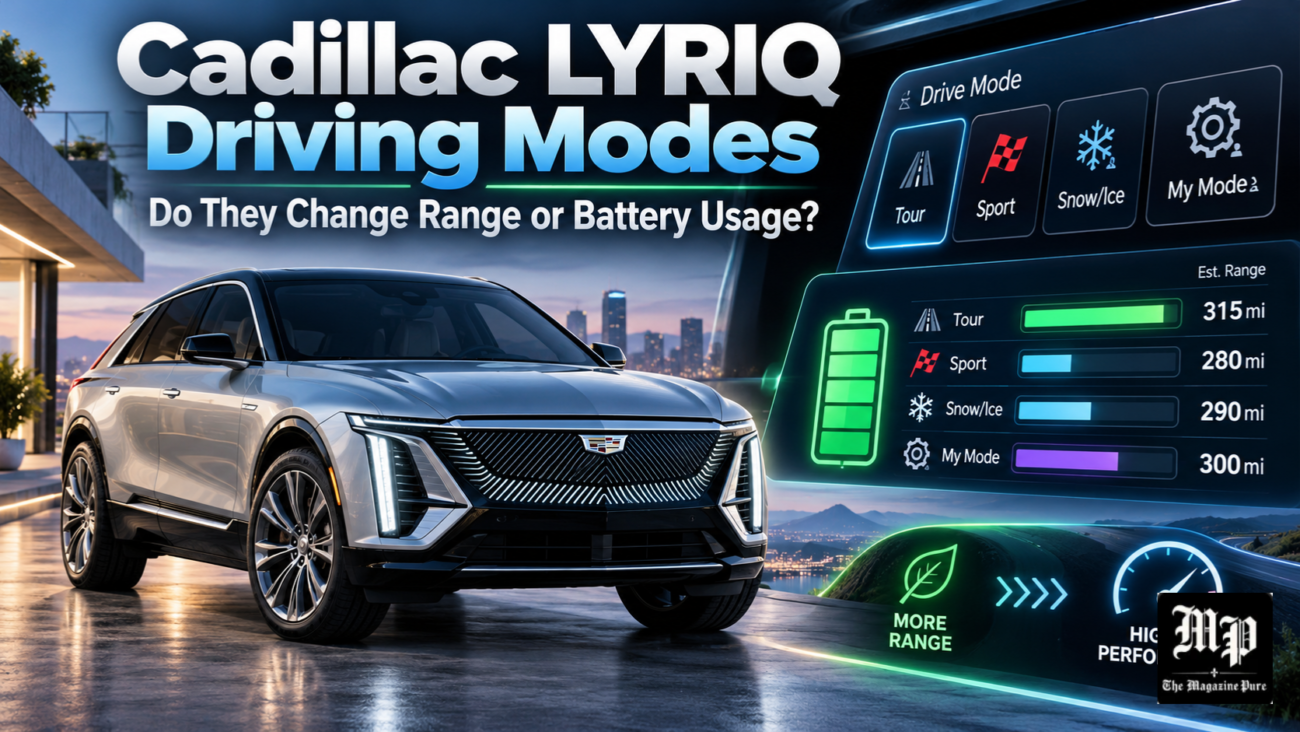
However, driving modes do not increase or decrease the amount of electricity the battery can physically store. Cadillac does not provide separate EPA-estimated ranges for Tour, Sport, Snow/Ice, or My Mode. Instead, the vehicle has an official range based on its motor configuration and equipment. Actual driving distance depends on road conditions, weather, vehicle speed, and driving habits. A careful driver using Sport Mode may achieve better efficiency than an aggressive driver using Tour Mode.
Tour Mode and Its Effect on Battery Efficiency
Tour Mode is designed for comfortable everyday driving and offers a balanced combination of acceleration, steering, and handling. It is generally the most suitable setting for commuting, city travel, and longer highway journeys. The smoother accelerator response helps drivers manage power delivery without encouraging sudden movements. This makes Tour Mode a practical option for people who want a relaxed driving experience while maintaining reasonable energy efficiency.
Although Tour Mode is often associated with economical driving, it does not automatically guarantee the longest possible range. Battery consumption still depends on how the vehicle is driven. Rapid acceleration, excessive speed, and frequent braking can increase electricity usage even when Tour Mode is active. Drivers who maintain moderate speeds, accelerate gradually, and avoid unnecessary stopping may experience better efficiency. For most LYRIQ owners, Tour Mode is a convenient everyday setting because it combines comfort, predictable handling, and the potential for efficient driving.
Sport Mode and Increased Battery Consumption
Sport Mode provides a more responsive driving experience by adjusting accelerator response and steering characteristics. The LYRIQ reacts more quickly to accelerator inputs, allowing drivers to enjoy the strong torque available from its electric motors. This setting is particularly appealing during highway merging, overtaking, or driving on suitable roads where quicker responses are desirable. Depending on the vehicle’s equipment, Sport Mode may also influence suspension behaviour and other performance-related settings.
Sport Mode can lead to higher battery consumption when drivers frequently use its stronger acceleration response. Rapid acceleration demands considerable electrical power, which can reduce the distance available before recharging. However, simply selecting Sport Mode does not automatically reduce range by a fixed percentage. If a driver maintains the same speed and uses similar acceleration in both Tour and Sport modes, the difference may be relatively small. The greatest impact usually comes from driving behaviour rather than the mode itself. Drivers prioritising efficiency should avoid repeated hard acceleration.
Snow/Ice Mode and Cold Weather Driving Range
Snow/Ice Mode is designed to improve vehicle control on slippery roads. It adjusts accelerator response and relevant traction settings to help reduce unwanted wheelspin. This is particularly useful when driving on snow-covered streets, icy roads, or other surfaces with limited grip. Instead of delivering strong torque immediately, the vehicle responds more gently to accelerator inputs. This helps drivers maintain smoother movement and reduces the likelihood of losing traction during acceleration.
Snow/Ice Mode is not specifically designed to extend battery range. Although reducing wheelspin can prevent unnecessary energy loss, winter conditions often increase overall electricity consumption. Cold temperatures can affect battery efficiency, while cabin heating requires additional power. Snow-covered roads, winter tyres, and increased rolling resistance may further reduce driving distance. As a result, the LYRIQ may achieve a shorter range during winter even when Snow/Ice Mode is operating correctly. Drivers should select this mode for improved control rather than expecting major battery savings.
My Mode and Personalised Driving Efficiency
My Mode allows Cadillac LYRIQ drivers to customise selected vehicle characteristics according to their preferences. Depending on the vehicle’s equipment, drivers can adjust settings related to acceleration, steering, braking feel, suspension, and motor sound. This provides flexibility for people who want a driving experience that differs from the standard Tour or Sport settings. For example, a driver may prefer relaxed acceleration combined with more responsive steering for everyday journeys.
The effect of My Mode on battery consumption depends on the selected settings and driving style. Choosing a gentler accelerator response may encourage smoother driving, which can improve efficiency. However, selecting more aggressive acceleration settings may increase energy usage if the driver frequently demands strong performance. My Mode does not have its own official EPA range, and Cadillac does not claim that a specific custom configuration guarantees maximum battery efficiency. Drivers interested in conserving energy can experiment with comfortable settings while monitoring their average electricity consumption during similar journeys.
Regenerative Braking and One-Pedal Driving in Cadillac LYRIQ
Regenerative braking is an important feature that can help improve electric vehicle efficiency. When the Cadillac LYRIQ slows down, its electric motors can recover some of the vehicle’s movement energy and return it to the battery. This reduces the amount of energy that would otherwise be lost during braking. The LYRIQ includes One-Pedal Driving, which allows drivers to control much of their acceleration and deceleration through the accelerator pedal. Depending on the setting, releasing the accelerator produces different levels of regenerative deceleration.
The vehicle also features Regen on Demand, which allows drivers to request regenerative braking through a steering-wheel paddle. These systems can be useful during city driving, where frequent slowing and stopping are common. However, stronger regenerative braking does not always mean better efficiency. Maintaining a steady speed and avoiding unnecessary acceleration can conserve more energy than repeatedly accelerating and braking. Regenerative braking may also be limited when the battery is nearly full or outside its preferred temperature range. Drivers should follow Cadillac’s guidance and avoid One-Pedal Driving on slippery roads.
Cadillac LYRIQ Battery Capacity and Official Driving Range
The 2026 Cadillac LYRIQ uses a battery with a rated capacity of approximately 102 kWh. Its driving range varies according to the vehicle’s motor configuration and equipment. The rear-wheel-drive version offers an EPA-estimated range of up to 326 miles, while the all-wheel-drive version can offer up to 319 miles in the specified standard configuration. Another AWD configuration has a 303-mile rating. The performance-focused LYRIQ-V has a separate estimated range of 285 miles. These figures reflect different vehicle specifications rather than differences between selectable driving modes.
Rear-wheel-drive and all-wheel-drive models have different propulsion systems, power outputs, and energy requirements. The AWD version uses two electric motors, providing additional traction and stronger performance. The LYRIQ-V focuses more heavily on acceleration and performance. These mechanical differences can influence efficiency even when the same driving mode is selected. It is important to remember that EPA figures are estimates obtained through standardised testing. Actual mileage can vary considerably depending on driving speed, outside temperature, terrain, and the amount of energy used for heating or cooling.
Other Factors That Affect Cadillac LYRIQ Battery Usage
Driving modes are only one part of the LYRIQ’s overall energy consumption. Vehicle speed can have a particularly noticeable effect because aerodynamic resistance increases at higher speeds. Frequent rapid acceleration also demands additional electricity. Road conditions, tyre pressure, passenger weight, and steep hills can influence efficiency. For example, driving uphill requires more energy than travelling on level roads, while underinflated tyres increase rolling resistance. These factors can reduce range regardless of which driving mode is active.
Weather conditions also play an important role. During winter, the battery and passenger cabin may require additional heating, increasing electricity consumption. In hot weather, air conditioning and battery cooling can place extra demands on the electrical system. Short journeys may be less efficient when the vehicle repeatedly needs to adjust its temperature. Battery age and condition can also affect available driving range over time. Understanding these influences helps drivers avoid assuming that every change in estimated range is caused by switching between Tour, Sport, Snow/Ice, or My Mode.
How to Improve Cadillac LYRIQ Range and Reduce Battery Consumption
Drivers who want better battery efficiency should focus on smooth acceleration, moderate speed, and sensible climate settings. Tour Mode is a good starting point for ordinary driving, while My Mode can be adjusted to encourage gentler accelerator inputs. Avoiding sudden acceleration and unnecessary braking can help conserve energy. Maintaining the correct tyre pressure and removing unnecessary cargo may also improve efficiency. On longer journeys, planning charging stops and considering weather conditions can help drivers manage their available range more confidently.
Monitoring energy consumption is another useful practice. The LYRIQ provides vehicle information that can help drivers understand electricity usage and estimated remaining range. Comparing miles per kilowatt-hour across similar journeys can reveal how different driving habits affect efficiency. Cadillac also recommends an approximately 80% charging target for typical daily use, with higher charge levels available when longer trips require additional range. Ultimately, consistent driving habits and sensible charging practices are more reliable ways to manage energy than depending on a particular driving mode alone.
Conclusion
The driving modes in the Cadillac LYRIQ can influence battery consumption and real-world driving range, but they do not directly change the battery’s capacity. Tour Mode provides balanced everyday performance, Sport Mode offers quicker responses, Snow/Ice Mode supports traction on slippery roads, and My Mode allows personalised driving settings. Each mode serves a different purpose, and its effect on efficiency depends largely on how the vehicle is driven.
For drivers who want to maximise range, Tour Mode combined with smooth acceleration, moderate speed, and appropriate regenerative braking is generally a practical choice. Weather, road conditions, vehicle configuration, and climate control can have a greater impact on battery usage than switching modes. Understanding these factors helps Cadillac LYRIQ owners enjoy better efficiency without sacrificing comfort, safety, or driving enjoyment.
