
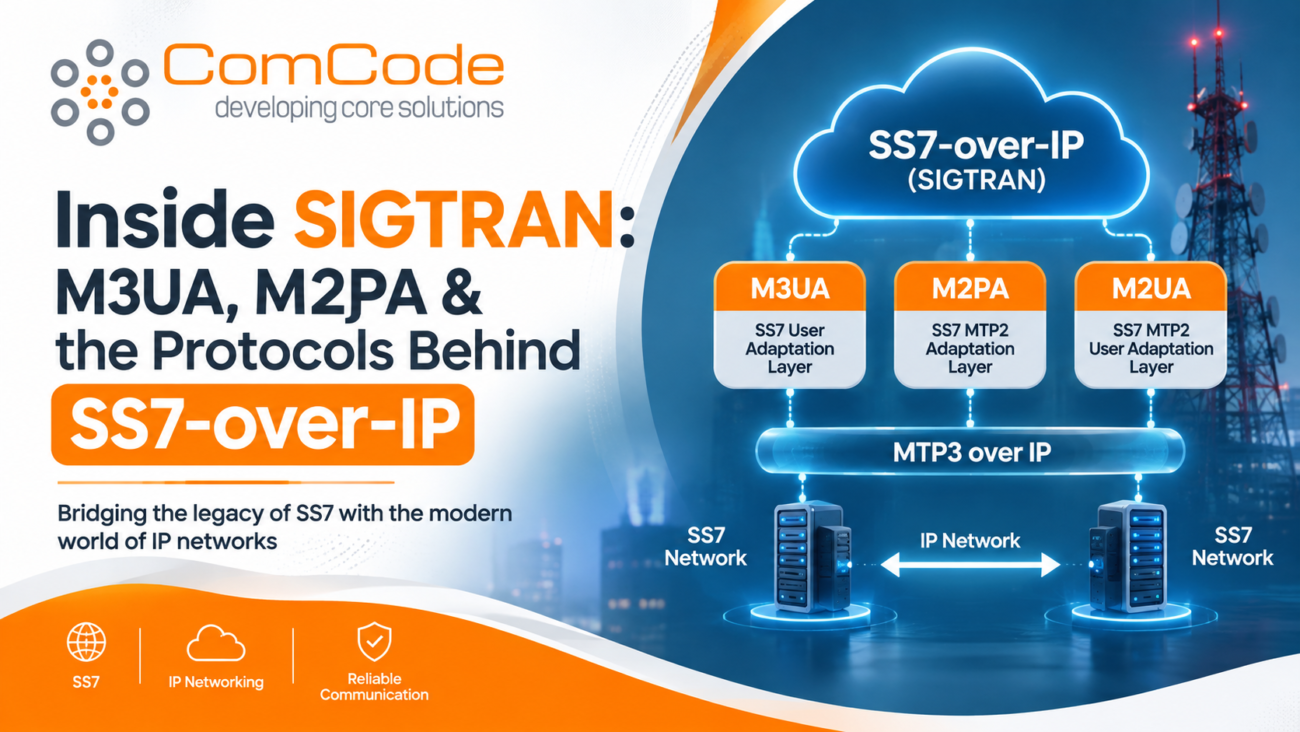
Why SS7 Moved to IP
Signaling System No. 7 (SS7) has been the backbone of telephony signaling for decade’s. It handles call setup, number translation, roaming, SMS delivery & USSD. It was designed for circuit-switched TDM links, which are expensive, capacity-limited & increasingly hard to maintain.
As operator’s moved to IP-based infrastructure, a question followed: how do you keep SS7 applications such as MAP, CAP & ISUP running without dedicated E1/T1 links? The answer is SIGTRAN, a family of protocol’s that transports SS7 signaling over IP network’s.
What Is SIGTRAN?
SIGTRAN is a set of IETF-defined protocol’s for carrying circuit-switched signaling over IP. It doesn’t replace SS7’s application layers. TCAP, MAP, CAP & ISUP stay the same. SIGTRAN replaces only the lower transport layers, which is why operators could migrate without rewriting every service.
The main benefits:
- Lower cost: IP links replace dedicated TDM circuits.
- Scalability: capacity grow’s with bandwidth rather than with the number of physical channel’s.
- Flexibility: signaling node’s can be geographically distributed.
- Redundancy: multi-homing & multiple path’s improve resilience.
The SIGTRAN Protocol Stack
SIGTRAN has three layer’s:
- Common Signaling Transport (SCTP): the transport protocol underneath everything. Unlike TCP, SCTP support’s multi-homing (several IP addresses per endpoint), multi-streaming & built-in heartbeat & failure detection.
- Adaptation layers: these “adapt” SS7 to SCTP. The main one’s are M3UA, M2PA, M2UA, SUA & IUA.
- SS7 application layer’s: SCCP, TCAP, MAP, CAP & ISUP run on top, mostly unchanged.
SCTP is the foundation of SIGTRAN’s reliability & it also underpins other telecom interfaces such as those in LTE & 5G.
M3UA vs. M2PA: Which One & When
The two most deployed adaptation layers are M3UA & M2PA. They solve different problems.
M3UA
M3UA replace’s MTP3 & below, delivering SS7 user-part message’s (such as SCCP or ISUP) directly over SCTP. It works in a client-server model between an Application Server Process & a Signaling Gateway or another ASP.
Key points:
- Uses routing contexts & routing keys to identify traffic.
- Supports load-sharing & override modes across multiple ASPs.
- Doesn’t require the endpoints to be full SS7 signaling points in the traditional sense.
- Commonly used between IP-based nodes such as STP’s, signaling gateway’s & application platform’s.
M2PA (MTP2 Peer to Peer Adaptation Layer)
M2PA replaces MTP2, so an IP link behave’s like a traditional SS7 link between two full signaling point’s. Each endpoint has its own point code & run’s MTP3.
Key point’s:
- Peer to peer rather than client-server.
- Preserves MTP3 functions such as link sets & signaling route management.
- Often used for STP-to-STP connections when migrating from TDM links to IP.
Quick Comparison
| Feature | M3UA | M2PA |
| Replaces | MTP3 & below | MTP2 |
| Architecture | Client-server (SG/ASP) or peer | Peer-to-peer |
| MTP3 required at endpoints | No | Yes |
| Typical use | Gateway & application connectivity | STP-to-STP link replacement |
| Point codes | Endpoints may share or use routing contexts | Each endpoint has its own |
Rule of thumb: use M3UA to connect application nodes to a signaling gateway or STP. Use M2PA when you want an IP link to behave exactly like a legacy SS7 link.
Gateway Connection: Bridging TDM & IP Networks
A Gateway Connection is where SIGTRAN becomes practical. A Signaling Gateway sits between the legacy SS7 (TDM) network & the IP network, converting between the two. It terminate’s the MTP2/MTP3 link’s on the SS7 side & expose’s the signaling to IP-based application server’s via M3UA.
A well-designed gateway connection should include:
- Redundant SGs in separate locations, so one failure doesn’t isolate the network.
- Multi-homed SCTP associations across diverse network paths.
- Correct point code & routing configuration, since mistakes here cause routing loops or black-holed traffic.
- Monitoring of association status, link utilization & message rates.
Gateway connections are also where interconnect partners, roaming hubs & international carriers link to your network, which makes them an important security boundary.
SIGTRAN & the SMS Firewall
Because SS7 was designed on the assumption of a closed, trusted network, it has no built-in authentication between signaling nodes. Once SS7 became reachable over IP & through interconnect’s, that trust model became a weaknes’s. Attackers with network access can abuse signaling message’s for location tracking, SMS interception, spoofing & fraud.
An SMS Firewall sits on the signaling path, usually integrated at the signaling gateway or STP & inspect’s SMS-related traffic such as MAP message’s for mobile-terminated & mobile-originated SMS.
Typical functions include:
- Blocking spoofed sender’s: checking whether the calling party’s identity is consistent with the message origin.
- Preventing location-tracking querie’s: blocking MAP request’s that expose subscriber location or serving node information to unauthorized partie’s.
- Detecting grey routes & SMS bypass: identifying traffic that avoid’s proper interconnect charges.
- Anti-spam & anti-fraud filtering.
- Home routing: hiding the real subscriber identifier’s (such as IMSI) from outside parties.
For the firewall to work, it must correctly terminate & inspect SIGTRAN association’s, which is why a clear understanding of M3UA & the gateway layout matter’s before deploying one.
From SS7 to Diameter: The Diameter Routing Agent
SIGTRAN carrie’s SS7 signaling, but 4G/LTE networks use Diameter instead. Diameter run’s over TCP or SCTP & its interface’s replace the MAP operation’s used in 2G/3G.
A Diameter Routing Agent (DRA) does for Diameter what an STP does for SS7. It:
- Routes Diameter messages between network elements, such as MMEs & HSSs, in large networks.
- Provide’s load balancing & topology hiding.
- Simplifie’s connectivity, so each node connect’s to the DRA instead of to every peer.
- Enforces policy & interworking & can add security filtering.
Most operator’s run both worlds at the same time: SIGTRAN for 2G/3G & legacy service’s & Diameter for 4G. The DRA & the SIGTRAN signaling gateway often sit side by side, sometime’s with an interworking function that translate’s between MAP & Diameter for roaming between generation’s.
The Home Subscriber Server & Its SS7 Roots
The Home Subscriber Server is the central subscriber database in 4G/LTE & IMS network’s. It stores subscription profile’s, authentication data & the current serving node for each subscriber. It is the evolution of the Home Location Register used in 2G/3G networks.
The key difference is in how each is reached:
- The HLR communicates over SS7/MAP, carried across IP via SIGTRAN.
- The HSS communicates over Diameter, through the DRA.
Many operators deploy a combined HLR/HSS (sometimes called a converged subscriber database) that serves both. It answers MAP requests arriving over SIGTRAN from 2G/3G networks & Diameter requests arriving through the DRA from 4G networks. This lets operators keep legacy subscribers & roaming partners working while moving toward newer core networks.
Deployment Best Practices
- Plan point code’s & routing carefully. Document your network indicator’s, point code’s & routing context’s before configuring anything
- Use multi-homing. Configure at least two diverse paths per SCTP association.
- Tune SCTP timers. Default heartbeat & retransmission settings may be too slow for carrier-grade failover.
- Segregate signaling traffic. Keep it on dedicated VLANs or private networks, separated from general traffic.
- Secure the perimeter. Put an SMS firewall & signaling firewall at every interconnect point. Use IPsec or TLS transport if possible.
- Monitor continuously. Track association states, congestion & unusual message patterns.
- Test failover regularly. Redundancy you have not tested is not redundancy.
FAQ
Q1. SIGTRAN still relevant with 4G & 5G?
Ans. Yes, Many operator’s still run 2G/3G networks, legacy service’s such as SMS & USSD & international roaming that depend on SS7. SIGTRAN remain’s the transport for these, even as Diameter & 5G service-based interfaces take over newer services.
Q2. Difference between M3UA & M2PA?
Ans. M3UA replaces MTP3 & is typically used between a signaling gateway & application servers. M2PA replace’s MTP2 & makes an IP link behave like a traditional SS7 link between two full signaling point’s.
Q3. Why does SIGTRAN use SCTP instead of TCP?
Ans. SCTP offer’s multi-homing, multi-streaming & fast failure detection, all of which suit carrier signaling. TCP lacks these feature’s & its single stream can cause head-of-line blocking.
Q4. What is a Gateway Connection in SS7 networks?
Ans. It is the link between a legacy SS7 network & an IP network, usually through a Signaling Gateway that converts between TDM-based MTP & SIGTRAN protocols such as M3UA.
Q5. Why do operators need an SMS Firewall?
Ans. SS7 has no built-in authentication, so signaling message’s can be abused for SMS interception, spoofing, location tracking & fraud. An SMS Firewall inspect’s & filter’s this traffic to protect subscriber’s & revenue.
Q6. What is a Diameter Routing Agent used for?
Ans. A DRA routes Diameter messages between network elements in 4G/LTE networks. It provides load balancing, topology hiding & simplified connectivity, much like an STP does for SS7.
Q7. How is the Home Subscriber Server different from the HLR?
Ans. The HLR serves 2G/3G network’s over SS7/MAP, while the HSS serves 4G/IMS network’s over Diameter. Many operator’s use a combined HLR/HSS to support both.
Conclusion
SIGTRAN lets operator’s keep proven SS7 service’s running on modern IP infrastructure. Understanding the difference between M3UA & M2PA, designing resilient gateway connection’s, protecting traffic with an SMS firewall & integrating with Diameter Routing Agent’s & the Home Subscriber Server are all part of running a secure, future-ready signaling network.
If you are planning a SIGTRAN migration or signaling security upgrade, a clear architecture & a layered security approach will save time & reduce risk.
