
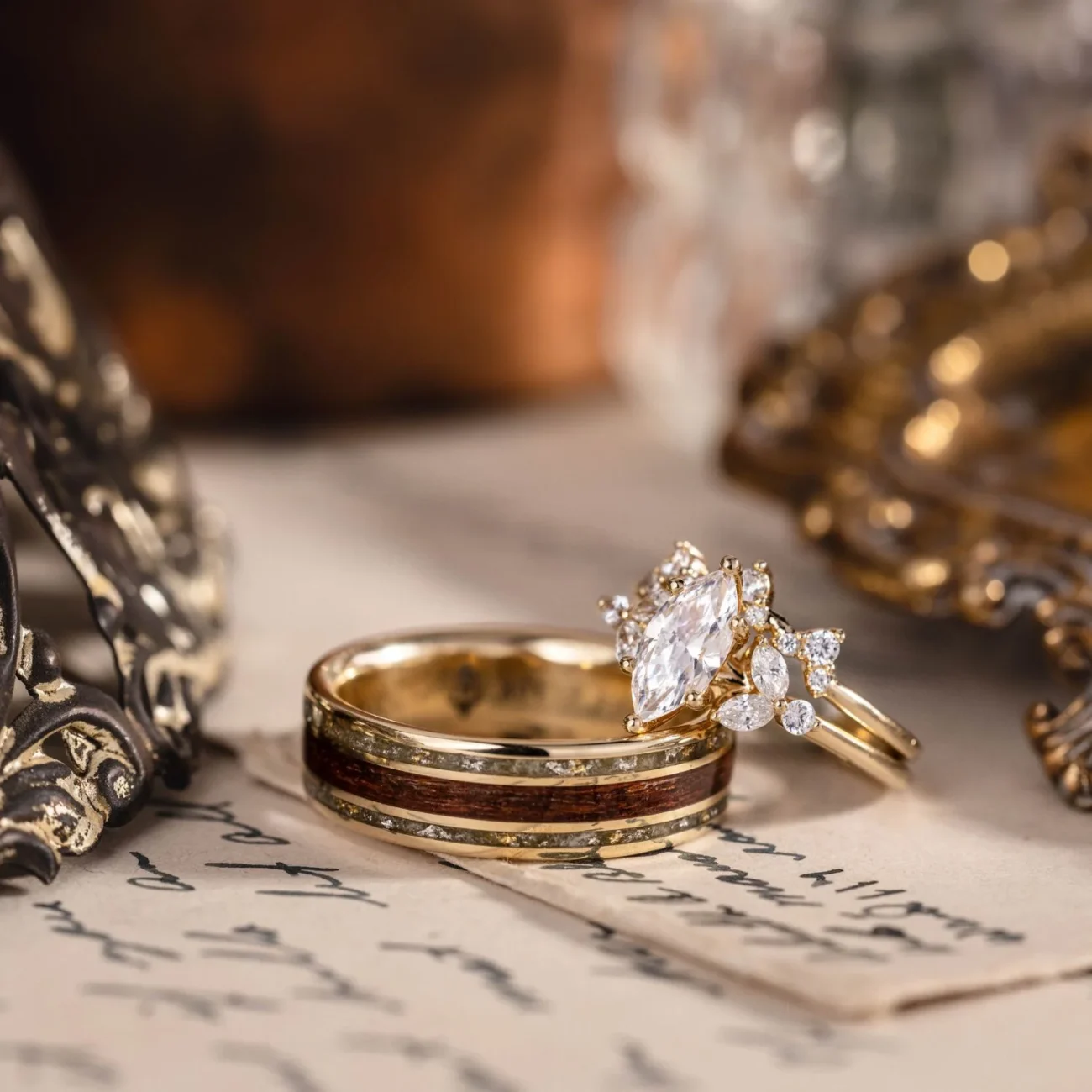
Bridal jewelry has always carried weight, but the expectations around it have shifted considerably. The idea that an engagement ring and wedding band must come from the same collection, the same metal, and the same era is quietly becoming a relic. What’s replacing it is something more personal, more layered, and far more interesting.
How Bridal Jewelry Styling Has Become More Individual
For most of the twentieth century, bridal ring sets were sold as a package. The logic was practical: a pre-matched pair guaranteed harmony on the finger without requiring any design knowledge from the buyer. Modern brides approach the process differently, treating the wedding band as its own decision rather than an afterthought to the engagement ring.
According to The Knot’s Jewelry Study, 47% of couples in 2024 chose non-matching styles that celebrate individual aesthetic preferences rather than traditional uniformity. That figure reflects something broader than a trend. It reflects a generation of buyers who grew up with access to editorial jewelry content, independent designers, and social platforms that reward originality over convention.
The shift also connects to how women wear jewelry in general. Rings are no longer ceremonial objects kept in a box. They are worn every day, styled with everything from a work blazer to a weekend outfit, and expected to hold up aesthetically across all of it. Daily life is the real test.
Why Matching Engagement Rings and Wedding Bands Are No Longer the Only Option
The matching set made sense when jewelry shopping happened in a single visit to a department store. Today, many brides inherit a family heirloom, source their engagement ring from a vintage dealer, or commission a custom piece from an independent jeweler. In each case, finding a factory-matched wedding band is either impossible or beside the point.
There is also a practical argument for separating the two decisions. An engagement ring chosen at one point in a relationship may not reflect the same aesthetic sensibilities a bride has developed by the time she is picking a wedding band. Treating the band as its own piece opens up a much wider range of possibilities and often results in a more considered final look.
Stacking, Curved Bands, and Mixed-Metal Combinations
Building a Stack with Intention
A growing number of women are not buying just one wedding ring. The wedding day band might be simple, and then an anniversary ring gets added a few years later, followed by another meaningful piece down the road. Instead of one ring telling the whole story, the stack grows with the marriage.
Starting a stack well means thinking ahead. A slim pavé band or a plain polished band sits flush against most engagement rings and leaves room for a second or third piece later. The goal is a stack that looks deliberate rather than accidentally accumulated.
Curved and Contoured Bands
V-shaped and curved bands have become a top choice for brides, and with more women stacking rings than ever, curved designs ensure gap-free, cohesive looks. They are particularly useful for engagement rings with larger center stones or unusual settings that a straight band cannot sit cleanly against.
Mixing Metals Without Matching
The old rule that every ring on the hand had to match in metal color has mostly gone out the window. Couples are pairing yellow gold with white gold, or adding rose gold accents next to platinum, without worrying about it looking mismatched. Done well, it actually looks more intentional, not less. A yellow gold band worn alongside a white gold solitaire draws the eye to both pieces rather than blending them into one undifferentiated band of metal.
How Diamond Shapes Influence Wedding Band Selection
The shape of the center stone has a direct effect on which wedding bands will sit well beside it. An oval or marquise stone tends to extend toward the finger’s edges, which means a straight band may leave a visible gap at the sides. A curved or chevron band solves this cleanly.
Round brilliants are the most forgiving. Roughly 58% of Western engagement rings feature a round diamond, which is part of why straight eternity bands and classic pavé styles remain so widely available. They work with the most common stone shape without modification.
Elongated shapes like emerald cuts and pear cuts pair well with baguette-set bands, which echo the angular, geometric quality of the stone. For brides shopping for women’s diamond wedding bands to complement a non-round center stone, the band’s profile matters as much as its metal or setting style.
The Return of Vintage-Inspired Bridal Jewelry
Milgrain edges, filigree detailing, and Art Deco geometric patterns have all made significant returns in bridal jewelry. The vintage moment that defined recent engagement ring trends is alive and well in wedding bands too. Antique-style bands work especially well for brides with heirloom engagement rings, where a contemporary band would create a jarring contrast.
The appeal goes beyond aesthetics. Vintage-inspired pieces tend to feature more intricate handwork, giving them a tactile quality that machine-finished bands often lack. For brides who want a ring that feels like it has a history, even if it was made last year, this category delivers.
Choosing Jewelry That Works Beyond the Wedding Day
A wedding band worn for decades needs to earn its place in daily life. That means thinking about how it sits on the finger during ordinary activities, how the finish holds up over time, and whether the design still feels current ten years from now.
Yellow gold has made a major resurgence in bridal jewelry, jumping from only 9% of rings in 2017 to 36% in 2024. Part of the reason is longevity. Yellow gold does not require rhodium plating to maintain its color the way white gold does, and it develops a warm patina over time that many wearers find appealing rather than problematic. It ages with you.
Building a Coordinated Look Without Sacrificing Personal Style
Coordination does not require uniformity. A stack of three rings in two different metals, each chosen independently, can look more cohesive than a matched set if the proportions and finishes are handled carefully. The connecting thread might be a shared stone shape, a consistent band width, or a repeating design detail like milgrain or beading.
The most wearable bridal jewelry tends to be the kind chosen with the whole look in mind rather than the wedding day alone. A band that works with a watch, layers well with fashion rings, and transitions from formal to casual is genuinely useful. One purchased purely to match a set may feel limiting by year three. That’s a long time to compromise.
The Takeaway
Bridal jewelry is most satisfying when it reflects how a person actually dresses, not just how they want to look in photographs. The matching set had its moment, and it still works beautifully for brides who want it. But the freedom to mix metals, stack with intention, and treat the wedding band as its own considered piece has made the whole category more interesting. The best place to start is with the engagement ring already on the finger and an honest look at what would genuinely complement it.
